Friday, July 7, 2017

Best Fundraiser EVER. Also, Breakfast of Champions

Here is what I had for breakfast


 I don't know what the "Las Vegas Classic" is.  I don't care.  It could be a stripper competition.  I don't care.  Fry bread, sausage, egg, and that plasticine cheap "cheese" product.  5$.  EVEN though I had to scrape off the cheese because the sammiches were already assembled, I didn't care.  I usually have a tantrum about incipient dairy.  This time, I didn't care.  The actual sandwich was quite a bit larger than pictured. 5$.  And seriously delicious.  I supported a local group, locally made food (the fry bread was fresh), and talked to several community members as we stood in line.

The limited run of 150 sammiches gave the sale quite a bit of cache.  No dawdling over decisions because they were going to run out.  It also means the folks making and serving didn't have to hang out for very long.  There are over 1000 people in this town.  They will run out fast.

At least 300 of us got paid this morning.  Good timing.  I got there a bit before 8 and the sandwiches were already going fast.  So much for "Indian time"..."fry bread time" means "show up early or miss out."


Friday, June 30, 2017

New skill! Cedar Baskets

My baskets are wonky, but sturdy. 

One piece of cedar bark folded, laced with cedar.  

There was a workshop going on where I work and I was allowed to jump in and learn.  Very fun.
And a great skill for the self-reliance quest.

Sunday, June 25, 2017

SWARM!!!!

Last weekend my bees swarmed!! I saw them go.  I had stared at the hives at about 8am.  No bees were out.  I thought maybe they were dead or had all left.  But really, 5 hives.  What are the odds they would ALL bugger off the same time?

At 10am or so I walked by again.  There were bees everywhere.  EVERYWHERE.  I heard a hum.  A LOUD hum.  Bees were pouring out of the hive of carniolans.  The hive I had split a few weeks ago.  Both that hive the the nuc I made from had looked plenty strong. Apparently they were.

Then I noticed at a buttload of bees were all apparently trying to eat about 5 flowers on the ninebark bush 10 feet from the hive.  I thought "That looks like a swarm."  Then it hit me.  IT WAS a swarm.  DUH.  It was my first time.  I was a swarm virgin.

Nice of them to wait until I was home and walking around.  Had it been a weekday, I wouldn't have been there and would have lost them all.

I went to the ninebark and sure enough, a beard of bees hanging off a branch.


I literally dropped what I was doing (had to go hunting for various tools after the swarm was dealt with) and ran get my bee stuff and figure out a new home.
I had an extra hive body, a top and inner cover and a couple of crap bottoms that I was going to make better one of these days...oops. 

Anyway, I put it all together and put in frames (note to self: next time put the frames in AFTER the bees). It's up on a pallet.  Didn't have bricks or blocks but perhaps one of these days.

I grabbed a rubber tub with a lid and headed to the swarm.  I shook the bee-jezuz out of the branch and many many bees fell into the box.  I laid the lid on gently and took them to the new hive, quite a ways from the old hive and facing away from the beeyard.  I want them to feel like they really moved.

I went back to the tree and there was a smaller beard on the
branch.  Must not have gotten the queen.  The 3rd trip back to check there was a tiny bee beard so I broke the branch off into the tub and took it all to the new hive.  I did one more trip just to be sure.

I fed them but didn't have a feeder I liked so I put sugar and warm water in a quart jar, put a few holes in the lid, then up ended it on an over turned muffin tin.  Worked just fine.


I didn't have any drawn comb to give them so put in empty frames of foundation.

Then I went to relax, hydrate (it was hot as blazes and I had to wear the bee hat. Didn't bother with gloves), and look up what to do about a swarm in my bee reference book.  I pretty much nailed it.  I have had some classes so I wasn't flying totally blind.  The book said that a swarm is all prepped to draw comb so it is the best time to set up bees in a box of empty foundation if one must do that.  Good to know.

They weren't all that interested in the sugar syrup so that is probably a sign they have plenty of real food out there.


Tuesday, June 13, 2017

Self-Reliance: Solar System

I went with solar to run the well.

There IS a power line crossing part of my property, and yet it would mean paying to set poles and run line to the homesite or well head or somewhere to get hooked in to that.  It was going to be  extremely expensive.  And then I'd be paying a monthly bill.

So, I skipped it.  As I plan the real cabin to live in properly, I'm planning to stick with stand-alone solar.  Not grid tie.  Grid tie here means paying to set those poles and hook up, and then having a more expensive solar system to avoid feed back and meter it and etc.  So, skip it.  I might get more panels.

Right now the system is 2 panels (I forget the size, but biggish, not crappy little ones), 8 batteries, a 24volt system into the inverter which runs the well and has an outlet on it.  There is also a charge controller, The panels are on a pole that can turn and tilt them.

I have learned that I should have gotten a 220/240V well pump, or a DC well pump, or a special one that can run on any power (220, 110, DC, whatever).  I got a 110.  Oh well.  We can't get it all right the first time.   It draws much amperage especially at start up so one scraped wire dropping volts meant it didn't work right for about a year until I found the right solar guys to figure out the issue.  That wire will be replaced when the real cabin goes in and the solar is moved and that portion will need to be re-wired. 

IF I wanted a fridge and washing machine and freezer and to live like someone on the grid, the solar would be too expensive or too high maintenance for me.  I will have lights, a bathroom fan, a few outlets, the well.  That's about it.  I may get a couple more panels to keep the charge up and I'm exploring microhydro and microwind for the not-so-sunny times, but that will probably end with exploration.

I'm not "self-sufficient" with the solar since someone built the panels and other components and I don't do my own wiring etc. I am self-reliant in that with this system in place, I am currently fulffilling most of my electrical needs.  I did bring the electric weed whacker and battery to work today to charge, but that was because I didn't want to leave the charger unattended, and yet I want to weed whack tonight while it's cool out.  I COULD have charged it at home.

Having the solar run the well pump, even the poorly chosen pump, is pretty darn self reliant.  The whole well/water system is pretty cool but I guess that's another post so I will save it.

Here is a picture of the solar panels and the well pump controller (power thingy) stuck on a post by the spigot.

Thursday, June 8, 2017

I Found the Tree!!!

It was closer to the bee yard than I remembered and I hadn't staked it immediately...then the hay left over from the land's previous life as a hay field grew as tall as the wee tree start.  Totally invisible until I nearly tripped on it.  I put in a stake and it has leafed out nicely.  This is the Wallis Cherry.  I may be spelling that wrong.

Friday, June 2, 2017

One of My Personal Heroes: Tyrone Hayes

Dr. Hayes is a biologist at Berkeley, UC Berkeley that is, who studies atrazine effects.  Atrazine is an herbicide used for a variety of things, especially corn crops.  Lots on corn.  I saw a map of atrazine use per acre of agricultural land and my home town is in the red zone.  For reals.

Anyway, Dr. Hayes studied what this atrazine would do to frogs.  At levels lower than EPA standards, atrazine chemically castrated the male frogs (they not only didn't turn into male-looking frogs, they made eggs, mated with other males, and had live baby frogs come out of those eggs).    The atrazine manufacturer who was paying for this study thought many things...one of which was that perhaps Dr. Hayes could report the results differently.  Perchance in a way that made it look like atrazine didn't do that. He said, "No."  He stuck with that.  He is a hero of mine.

Here he is on Democracy Now a few years ago:
https://youtu.be/IOOOZi6TI1s

Sunday, May 28, 2017

Self-reliance: Reference Library


1) Reference library.  I can find stuff out without a smartphone or even the interwebs!!!! OMG.  I'm rocking it 1990s style.


First: REMEMBER TO CHECK BOOKS OUT OF THE LIBRARY BEFORE YOU DECIDE WHETHER TO ADD THEM TO YOUR HOME REFERENCE LIBRARY.  

I didn't do this every time, but lots of times.  Once I decide I want something, like the Tightwad Gazette, I then start keeping an eye out at the free book bin at the Moscow, Idaho, recycling center, yard sales, and thrift stores.  If something is 25cents, I may get it and then feel free to donate it to a thrift store or little free library or the free book bin if it's not quite what I want.


Here are a few book types in the library:

--Budget/Thrift/Frugality manuals
        My favorites are The Complete Tightwad Gazette (from a thrift store) by Amy Dacyczyn, The Ultimate Cheapskate's Guide to True Riches by Jeff Yeager, various olde tyme housekeeping and thrift books from the recycling center free book bin or 25cents or less at thrift and yard sales.  I try to cull these every year or two.
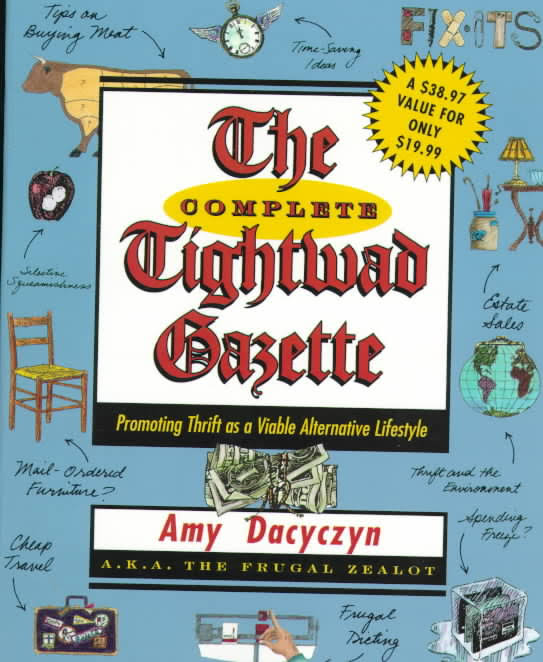
Image result


--Cookbooks (real ones) and recipes
         Old cookbooks are better for me in general.  Ones where the recipes start with flour, milk, eggs, rather than "a box of cake mix."  Others might like something else.  The classic Better Homes and Gardens cookbook with guides on roasting meats, making bread and cakes from scratch, how to cut up a whole chicken, etc, is a great place to start.  I got two excellent reference cookbooks from a friend (Hi Jon!) who got them at thrift.  Debra Madison's Vegetarian Cooking for Everyone and Cooking Under Pressure by Lorna Sass.  Both have guides to cooking many many vegetables.  I use these as guides once I've learned how to deal with a meat or veg product.  I also check out cookbooks from the library and copy out the recipes I like.  A collection of recipes from family, friends, and events needs culling right now, but often serves as inspiration.  I also have a couple of solar cooking cookbooks that I found in the free book bin at the recycling center.
         Food preservation books on fermenting, canning, dehydrating and root cellaring are also in there.

--First Aid and Home Healthcare References
       I found both at thrift stores.  The first aid manual is an scouting one.  The healthcare is based on nutrition and herbs that probably grow in the garden.          

--Basic carpentry how-to
       This mostly lets me know that something is beyond my skills, but good to have.

--Various low cost and energy efficient housing design books (Alex Wade is my hero!!!!)
       These were and are used for planning my "real" house that I hope to have built eventually.


--Beekeeping book (Thanks Hilch and the girls!!!  Great gift)
         This one is a nice basic reference.  There are tons out there so I don't know if it is the best but it is very good.   I am on the look out for an old version of The ABC and XYZ of Bee Culture partly as useful reference and partly for the history of beekeeping.


--Dictionary.  Actually 2.
          One basic new one and one vest pocket type from 1906!  Both found at thrift for about 25cents. 

--Manuals for my appliances, tools, systems, etc
        These come in SO HANDY when something breaks or I get the question "what is the model number?" or "when did you buy that?" from a repair person.  Write the purchase date, or at least year, on the cover and store them either all together in a good sturdy box, or in a protective bag/cover and on the wall right by the appliance/tool/system.

--Plant/Animal Identification guides
        I have wild plants (medicinal, food, and otherwise), wildlife, birds, and would like a good mushroom guide.  I also have free e-books on weeds and local native plants.   I may print them out so I don't have to turn on the computer to find the info.


--Gardening/Orchard guides
         From the free book bin at recycling, I got the Sunset Western Garden Book from the 1970s.  Excellent!  I recently found a newer hardcover version at a thrift store for very cheap.  Currently deciding which to keep and which to put in a "tiny library" for someone else to have.  I also have a second gardening techniques book that is similar and may cull down to just one or the other.  I have an old copy of the Square Foot Garden, Let it Rot (composting), and a set of handouts on various plants from gardening classes.  I keep the notes from the garden/farm classes I attend in a hardcover notebook (that I got at a thrift store), so these notes are all together and I can find them.


--Repair and Maintenance and Hack guides.
      I haven't settled on the ones I like, but these are books on how to refinish furniture, fix household items, mend clothes, and the like.  An old housewife's guide from the 1800s has been extremely useful and was a gift from my gramma years ago.  I found a new general fix it guide at thrift that is being auditioned.

--Guide to my garden/orchard
     This is one I am putting together myself.  I haven't settled on a format but I'm thinking one page for each type of tree/shrub/cane-berry to record when/where I got it, when/where it was planted, and how it is doing.   I'll put in notes on annuals in another section or another notebook.


I switch out books now and then.